
AI Isn't Black and White
ai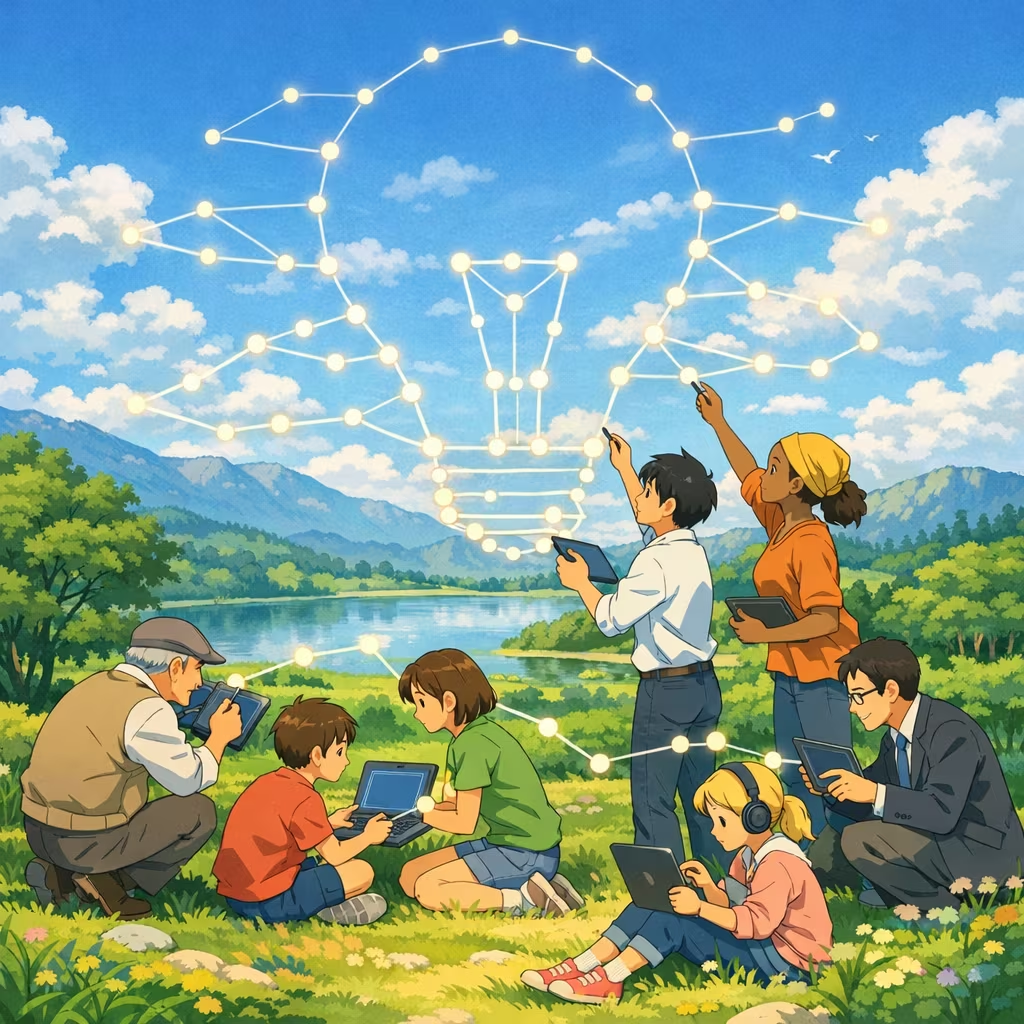
People of all ages and backgrounds come together outdoors, connecting ideas and technology to illuminate the diverse and collaborative nature of AI innovation.
Okay, this will probably sound controversial, but that's not my intent. I'm just sharing my thoughts because AI is everywhere right now, especially on social media and in blog posts.
These views range from fairly neutral:1
To fairly positive, with the idea that you need to learn or use AI because...
To more negative views, often focused on whether AI's value proposition can actually justify the money being spent:
People tend to frame the debate as two opposing camps: camp 1 wants nothing to do with AI, and camp 2 wants to hand it control over everything. I live in a quieter third camp. Most people are actually somewhere in the middle, but we don't shout as loudly. I see both the risks and the benefits. AI has let me try things I never would have had the courage to try, and it's helped me grow and learn about technology in ways I likely wouldn't have otherwise.
The loudest voices are camps 1 and 2, yet it's usually the middle camp that makes the real decisions when it counts. So maybe camps 1 and 2 should learn a little from us: camp 1 could be a little less rigid, and camp 2 could be more realistic and grounded.
AI is not going away. It may become less democratized. We are already seeing token, credit, and time limits, but those feel like temporary bumps. Many limits are at least partly artificial, and they may ease as the tech and business models evolve.
Given current politics here and abroad, tearing people down doesn't help. If AI isn't being used to create false narratives or spread fake news, people should be free to use it or not. I don't support blanket punishments for anyone who used AI to edit, help, or build something. That kind of hard-line stance, and labeling anything non-factual as slop, isn't productive.
The larger economic issue is real and has been building for decades. Automation started with the paperless office and industrial robotics. Robots and AI will continue to displace jobs, and that's a societal and political problem we need to solve now, not shrug off with it's not my problem. It's not necessarily tomorrow's crisis, but it's coming in the not-so-distant future.
Job losses mean less tax revenue, and corporations and wealthy individuals are skilled at finding legal ways to reduce taxes, wages, and benefits. We should rethink corporate structures and the single-minded focus on shareholder value. A shift toward an employee-and-business-first model would make more sense. After all, without a functioning business, you don't have shareholder value, and without employees, you don't really have a business unless you fully automate. If companies replace workers with machines and still expect high shareholder returns, they may under-invest in the equipment and long-term stability that would make that strategy sustainable.
That's my two cents. I don't think we should be tearing people down for using technology that helps them, that they pay for themselves, and that helps them communicate and complete their vision.
For full transparency, this post contains my thoughts and my opinions, and it was edited and proofread with AI. I made, directed, and approved the changes. AI helped organize my wording and corrected my spelling and grammar. It did not write this post, create the ideas behind it, or shape my feelings or thoughts. That, to me, is responsible AI usage.
I could not afford to hire an editor or an artist for this post, or every other post, to make a feature image. I told the AI what I wanted for a feature image, and it made it. I think it did an amazing job bringing my prompt alive.
-
I am using “views” broadly here. Some examples come from specific blog posts, while others come from podcasts, videos, comments, or general public statements I have seen or heard. ↩
